Chasing the hills
Chasing the Hills
From the chaos of Delhi to the sacred silence of the Himalayas — one road, four cities, a thousand memories.
When Delhi Said Goodbye
5:30 AM, New Delhi Railway Station — the city still dark, tea still hot
There is a particular kind of Delhi morning that belongs only to those catching early trains. The autorickshaw weaves through streets that are, blessedly, still half-asleep. Street vendors are lighting their first fires. Dogs sprawl in intersections without a care. The city that by nine o'clock will be a roaring furnace of horns and humanity is, at this hour, something almost gentle.
I had packed light — a 40-litre backpack, one good shawl, and a notebook with more blank pages than I probably deserved. My plan was simple: Dehradun first, then a swing down to Rishikesh, up to Mussoorie, and back home to Delhi within the week. Four cities. One state. One spine of the Shivaliks whispering through it all.
"The train doesn't just carry you out of Delhi — it peels the city off you, layer by layer, the further north it rolls."
The Shatabdi Express is the veteran of this route. I had a window seat. As New Delhi station's grey platforms slid away and the city's outer chaos gave way to flat agricultural fields, I felt something loosen in my chest. The Ganga plains glided past — mustard fields, a heron standing perfectly still in a roadside pond, a painted truck overtaking a bullock cart on a parallel road. India doing what India does best: existing in ten centuries simultaneously.
By the time the distant blue suggestion of hills appeared on the horizon, I'd finished two cups of pantry chai and was already writing my first notes.
The City That Breathes
Gateway to the Doon Valley — where the mountains begin to mean business
Dehradun is the kind of city that surprises you by being better than expected. I had half-imagined a dusty transit town, a mere waypoint. What I found instead was a relaxed, tree-lined city that carries its history with quiet confidence — prestigious schools, ISRO campuses, an old Tibetan colony, and basmati so fragrant it practically announces itself from the market stalls.
I checked into a guesthouse near Rajpur Road, dropped my bag, and immediately headed out on foot. The Paltan Bazaar is a wonderful rabbit-warren of shops selling everything from hiking boots to wedding sarees, and the smells shifting from block to block — incense, roasting peanuts, diesel, marigold — kept me walking far longer than I intended.
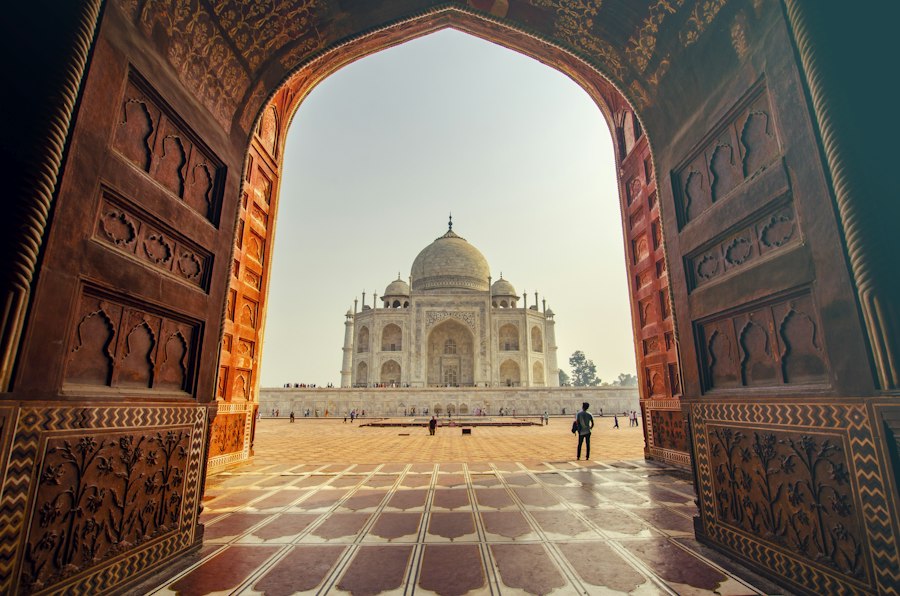
The Forest Research Institute campus was my afternoon stop. It's one of those colonial-era buildings that makes you stop walking and just stare — a Greco-Roman colossus surrounded by forests so well-tended they feel almost theatrical. The lawns were full of students studying under massive trees. I sat on a bench and did the same, except I was studying the kites circling overhead.
Dehradun — Don't Miss
- Forest Research Institute — the building alone justifies the detour, and the natural history museum inside is genuinely fascinating
- Sahastradhara — sulphur springs and limestone caves about 14 km from the city; magical in the early morning
- Paltan Bazaar evening walk — local food, local chaos, local life at its most vivid
- Mindrolling Monastery — one of the largest Buddhist centres in India; serene, beautiful, architecturally stunning
- Dehraduni basmati rice from a local shop — buy some, take it home, thank yourself later
I slept deeply that night. Dehradun sits at around 640 metres — not dramatically elevated, but enough that the air had a different quality. Cooler. Less particulate. The kind of air that makes you realize how long you'd been holding your breath without knowing it.
The Ganga, Unfiltered
43 km from Dehradun — where the river comes down from the mountains and everything changes
The drive from Dehradun to Rishikesh takes about an hour, but it crosses a threshold that can't be measured in kilometres. The Ganga here is something else entirely — not the wide, slow, weary river of the plains, but a younger, faster, greener version of itself. The water is genuinely turquoise. You stare at it and think: that can't be real.
I arrived at Laxman Jhula in the late afternoon, just as the golden hour was beginning its slow performance. The suspension bridge swings gently over the Ganga, and crossing it — dodging monkeys who have zero concept of pedestrian right-of-way — is an experience that wakes you right up. On the far bank, ashrams and cafes and sadhus and Israeli tourists and yoga studios and little shops selling Rudraksha beads all coexist in a cheerful, noisy spiritual bazaar.
"Standing at the Ganga's edge at dusk, watching the Ganga Aarti's fire reflected in the current, I understood for the first time why people call rivers gods."
The Ganga Aarti at Triveni Ghat is not to be missed under any circumstances. As evening fell, priests in saffron robes performed the fire ceremony to the sound of bells, conches, and chanting that seemed to come from somewhere older than memory. The flames reflected in the black water. The crowd — pilgrims, tourists, holy men, curious children — pressed together at the ghats, all of them briefly unified by something they couldn't quite name.
I ate dinner at a small rooftop café overlooking the river: a thali that arrived in stages, accompanied by a view that no restaurant in Delhi could ever charge enough for. The mountains were dark shapes against a darkening sky. Somewhere across the water, someone was playing a flute.
Rishikesh — The Essential List
- Ganga Aarti at Triveni Ghat (evening) — arrive 30 minutes early to find a good spot near the water
- Ram Jhula and Laxman Jhula — both bridges are worth crossing; Laxman Jhula is older and more atmospheric
- White-water rafting on the Ganga — class II–IV rapids depending on season; absolutely thrilling
- Beatle Ashram (Chaurasi Kutia) — where the Fab Four meditated in 1968; now a beautiful ruin covered in graffiti murals
- Sunrise at any ghat — worth every minute of the early alarm
- Café culture on the Tapovan side — great coffee, good vibes, slow mornings
I spent two nights in Rishikesh. On my second morning I went rafting — a decision I almost didn't make and will never stop being glad about. The river grabbed our raft and shook it like a terrier with a toy. We screamed. We paddled like our lives depended on it (in certain stretches, they did). We arrived at the beach takeout point soaked, exhilarated, and somehow bonded with three strangers from Hyderabad who'd been in the raft with me.
Rishikesh does that. It creates connections — between you and the river, between you and the mountains, between you and people you met an hour ago.
The Queen of Hills
35 km above Dehradun — clouds that come in uninvited, views that justify everything
The road up to Mussoorie is itself a spectacle. As the car climbed the switchbacks from Dehradun, the Doon Valley spread out below with increasing grandeur — first the city rooftops, then the entire floor of the valley, then, as you round a particular bend near Kempty Falls, a panorama so wide it makes your lungs feel insufficient.
Mussoorie sits at roughly 2,000 metres. The British established it as a hill station in the 1820s, and if you squint past the weekend tourists and the traffic on the Mall Road, you can still sense that old, colonial-hill-station atmosphere — the stone churches, the Gothic school buildings, the particular kind of English-style tea shop that survived a century and two world wars and still serves toast with good jam.

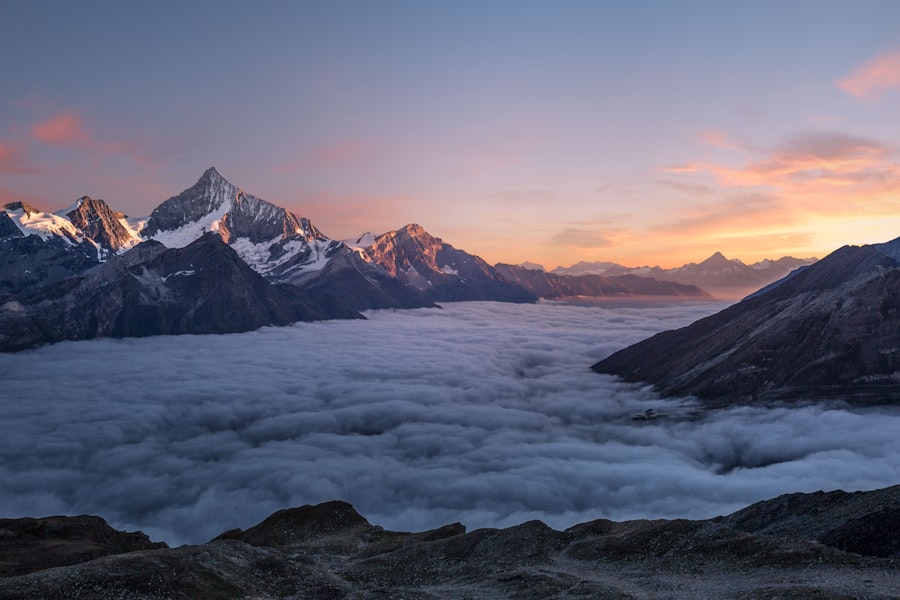
I walked Camel's Back Road in the early morning when most tourists were still asleep. The fog was thick enough to touch. Pine trees emerged from it and disappeared again. Below, Dehradun was invisible. Above, the higher ridges were a rumour. And then — just for twenty extraordinary minutes — the clouds broke and there they were: the snow peaks. White and enormous and completely indifferent to my awe.
"The Himalayas do not appear — they reveal themselves, briefly, on their own terms, as if granting an audience."
Gun Hill is worth the cable car ride (or the steep walk, if you're keen). The viewpoint on a clear day looks out towards Bandarpunch and the Gangotri range. I went twice: once in cloud, which was moody and beautiful in its own right, and once when the sky cleared briefly at 4 PM and the peaks turned pink in the pre-sunset light. Both versions were worth it.
The food in Mussoorie leans into its hill-station character delightfully. I had maggi noodles with extra chillis at a dhaba overlooking the valley (an Uttarakhand hill tradition that cannot be improved upon), and a surprisingly excellent Continental meal at a hotel restaurant that seemed to be operating out of a different decade entirely, which was its own charm.
Mussoorie — What to Do
- Camel's Back Road at dawn — bring a jacket, bring patience, wait for the Himalayan peaks to emerge
- Gun Hill via cable car — best views in town on a clear day
- Kempty Falls — magnificent waterfall 15 km from town; go early before the weekend crowds arrive
- Landour — the quieter, older, higher neighbourhood; walk its lanes, visit the famous bakery, breathe
- The Mall Road at twilight — chaotic, lively, excellent for people-watching and corn on the cob
- Ruskin Bond's Ivy Cottage area — the beloved author still lives here; the whole area has a bookish, gentle quality
I spent an afternoon in Landour — the quiet cantonment above Mussoorie proper — sitting in a small bookshop, reading, listening to the wind in the deodars outside. Ruskin Bond, who has written so beautifully about these hills for decades, still lives up here. The whole neighbourhood has absorbed something of his gentle, attentive quality. People walk slowly. Nobody seems to be in a hurry. The hills impose their own tempo.
Delhi, Again
The city welcomes you back the only way it knows how — loudly
The return to Delhi from Mussoorie and Dehradun is a descent in every sense. You leave the pine forests and the cool air and the unobstructed sky, and with every kilometre south the heat reasserts itself, the traffic thickens, and the horizon closes in. By the time you're back in New Delhi, you could almost convince yourself the mountains were a dream.
Almost. Except your shoes still carry Gangetic silt. Your notebook has the smell of deodar smoke. And somewhere in the back of your mind, a turquoise river is still running, cold and fast, between green mountains under a blue sky that has no ceiling.
"Delhi doesn't let you return quietly. It absorbs you back into itself, and you wonder how you ever left — and already when you'll leave again."
I came home sunburned, slightly sore from the rafting, carrying too much packaged pahadi honey and not enough clean clothes. I came home having stood on a suspension bridge over the Ganga in the golden hour. Having watched snow peaks appear from cloud. Having eaten the best roadside maggi of my life at 2,000 metres with a borrowed view of the whole of North India below.
The Uttarakhand circuit — Delhi, Dehradun, Rishikesh, Mussoorie — is not a complicated journey. It doesn't require extreme planning or significant expense. What it requires is simply the decision to go. The mountains will do the rest.
Go. Pack light. Keep the window seat. Watch for herons.
Until the Next Road Calls
Every journey changes the person who takes it. This one reminded me that mountains are patient — they'll wait as long as it takes for you to remember they exist.
Comments
Post a Comment